In this article
WORKFLOW
A single sample is a conversation. Fifty patches are a process. The shops that lose money on short runs are not bad at stitching. They redo the tenth patch because nobody wrote down which twill, which backing, and which file actually got approved.
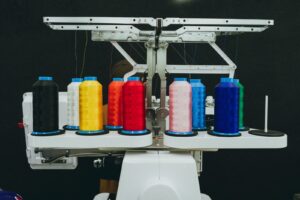
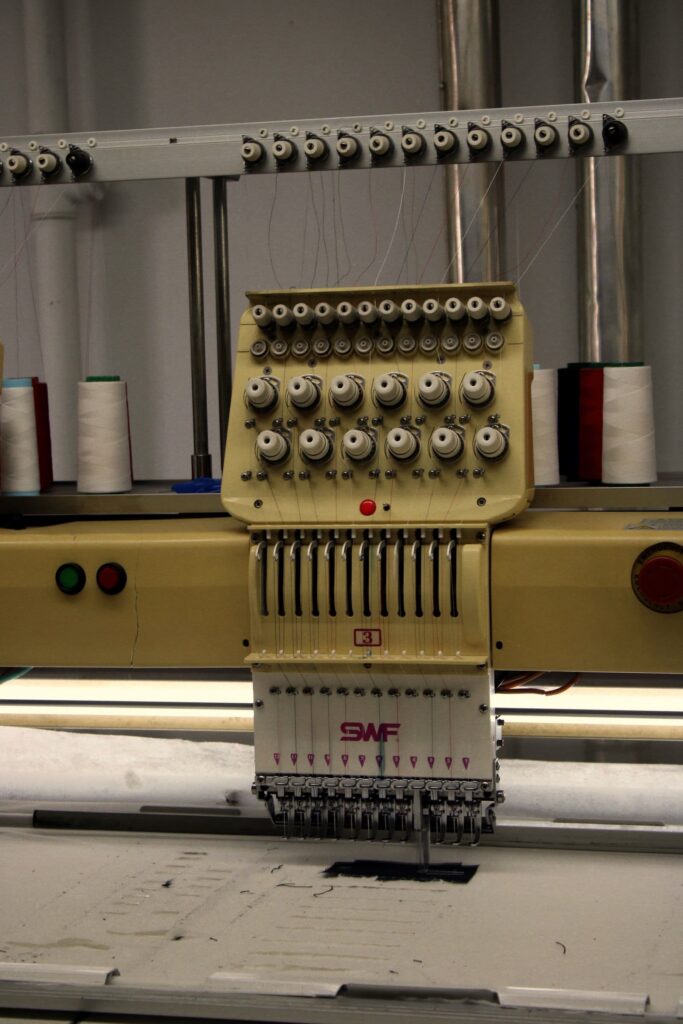
Example photo, not a batch of finished patches. A production embroidery machine. Photo by İlknur Çelik on Pexels.
Do not gang the sheet until one patch is ugly in the right way
Sew one. The full size, on the real twill, with the real backing and the real border. Wash it if the customer is going to wash it. Put it in their hand, or at least in a photo they reply to. A proof on the wrong fabric is how you get a yes and then a complaint.
Only then export the gang. Leave enough gap that a hot knife or a pair of scissors does not wander into the neighbor. The border sews last. If your tearaway is light, that last border is where a whole row goes slack. Use a backing that survives the end of the run, not just the first patch. The materials side of this is twill, felt, and the films.
Write the ticket like you will forget
- File name, size, and the date they approved it. Not the date you started.
- Fabric, stabilizer, topping if any, and the thread colors in sew order.
- Border type and width. Satin and merrow are not interchangeable at the end.
- How it attaches: sew-on, iron-on, Velcro. Heat and time if there is a film.
- How many you cut, how many you rejected, and why.
Rejects are part of the count
A birdnest in patch three, a border that skipped, a color that ran out and got replaced with a close-enough cone: those do not go in the bag. They go on the ticket, because that is the real thread and the real time. Pricing falls over when the quote assumed every patch was perfect and the hoop never had to be redone.
If the same fault shows up more than twice, stop the run. Another forty copies of a walking registration is not productivity. Fix the hoop, the file, or the stabilizer, then start the count again.
Bag them so the customer can check without destroying the stack
Same orientation, same way up, a count written on the bag. If iron-on instructions matter, they go in the bag, not in an email they will not find. A short run feels personal. The second order feels professional only if it matches the first without you having to remember it.
Questions that come up at the machine
Can I skip the single sample on a reorder?
Only if the ticket matches and the materials are the same lot. A new twill is a new sample.
How many extras should I sew?
Enough to cover the rejects you actually have, not a magic percent. After a few runs you will know your own number.
What if they approve a screenshot, not a patch?
You approved a picture. Sew one real patch before the gang, or you are gambling the whole sheet.

Founder of Plan & Make. Writes about embroidery production, patches and digitizing. Every guide is reviewed against real production constraints.
About Plan & Make →PUT IT INTO PRACTICE
Turn your artwork into a sew-ready file.
Upload a clean logo, check the front preview and download DST, PES, JEF, EXP, VP3 or XXX.
Open StitchForge →