In this article
HATS
Flat goods forgive you. Hats do not. The frame only holds a curve, the seam is in the middle of everything, and an unstructured cap has nothing stiff inside it. Most bad hat jobs are hooping and stitch order, blamed on the file.
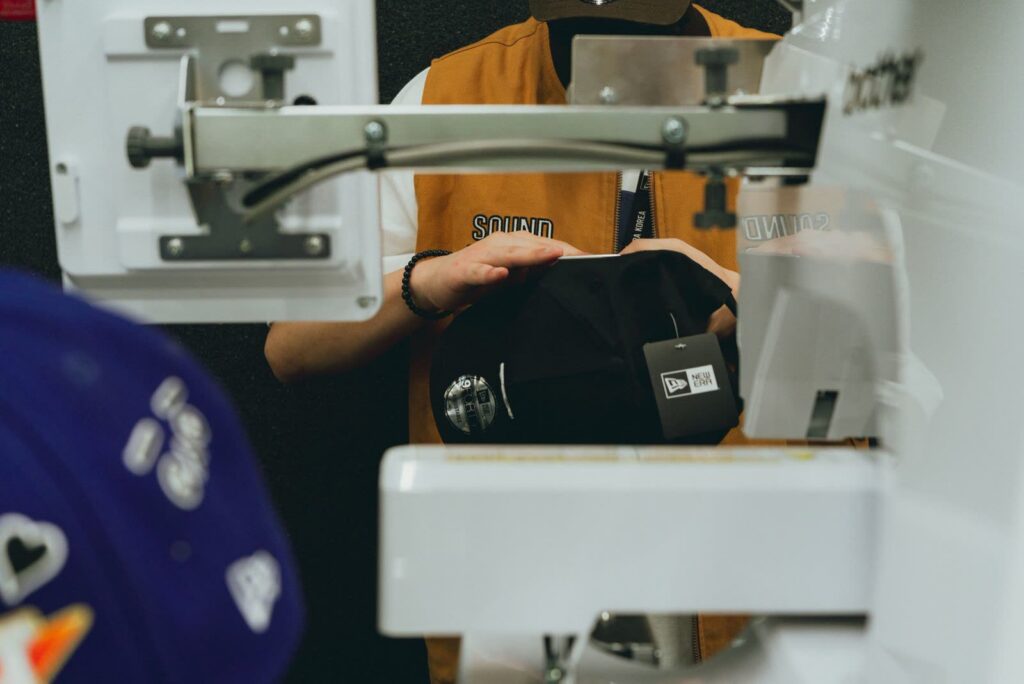
Example photo, not a Plan & Make sew-out. A cap at a multi-needle machine. Photo by Theodore Nguyen on Pexels.
Structured and unstructured are different products
A structured cap has buckram. It sits in a cap frame and stays put if the sweatband strap is in the seam along the bill and the sides are clipped down. An unstructured dad hat has no buckram. It swishes. Regular hat tearaway is often not enough. Two layers of cutaway, cut no taller than a normal hat stabilizer, plus a little adhesive, is the setup people land on after the third ruined sample. Stabilizer that sticks up too far catches the free arm and drags.
If a customer wants a flawless logo on an unstructured hat, say no, or say it will be imperfect. You own the machine to ship work, not to spend half a day on one foam-front cap that was never going to sit still. Many customers accept a little movement if you told them first.
Sequence: bottom up, middle out
Digitize and sew from the lowest point of the design toward the crown, and from the center outward. If the bottom element is text, start with the letters nearest the seam, run down one side, come back to the center, then the other side. Then climb to the next element. Left to right, the way you would sew a shirt, lets the cap shift the whole way and the right side lands late.
That order fights color changes. Sometimes you add a color stop you do not want so a lower element can finish before an upper one locks it in the wrong place. Annoying. Cheaper than a box of crooked hats.
Test on the hat frame, not on a flat hoop and a prayer. A scrap of firm canvas with a center seam in the frame tells you more than a shirt test. Open the fill spacing a bit compared with flat goods. A fill that looks plush on twill becomes a lump on a cap.
Topping, backing, and the bill
Structured caps do not need water-soluble film on the face. There is nothing for the stitches to sink into. Knit beanies do. A bucket hat or a floppy crown often wants cutaway, not the stiff hat tearaway you use on a trucker front, and a basting run around the design so the cloth cannot creep before the logo starts.
The strap sits in the seam. Crooked strap, crooked design. It feels too simple to be the whole problem. Check it anyway before you reopen the digitizing.
What to tell yourself before you quote
- Structured cap: normal hat tearaway, center-out, bottom-up, strap in the seam.
- Unstructured: warn the customer, more stabilizer, less ambition in the artwork.
- Never promise 3 mm script across a seam.
- Sew one hat and look at it off the frame before you sew twelve.
Questions that come up at the machine
Why did only the right side of the text move?
The design was sewn across the cap instead of from the center out, or the hat was loaded tight on one side.
Do I need topping on a structured hat?
Usually no. Save the film for pile and knits.
Can I use the same left-chest file?
You can try. The sequence and the density will be wrong. Treat a cap file as its own file.

Founder of Plan & Make. Writes about embroidery production, patches and digitizing. Every guide is reviewed against real production constraints.
About Plan & Make →PUT IT INTO PRACTICE
Turn your artwork into a sew-ready file.
Upload a clean logo, check the front preview and download DST, PES, JEF, EXP, VP3 or XXX.
Open StitchForge →