In this article
STABILIZER
Stabilizer arguments go in circles because people compare different fabrics. Sew the same small design on a woven, a knit, and a towel. The loser shows up on the back, or a month later in the wash.
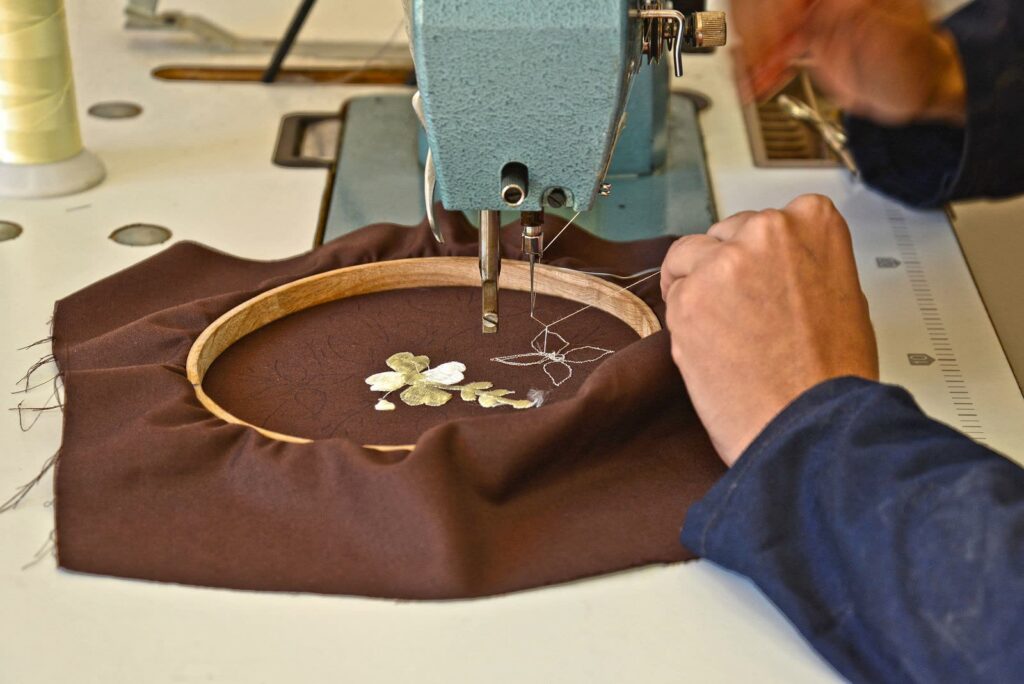
Example photo, not a Plan & Make sew-out. A machine stitching fabric in a hoop, not a side-by-side of cutaway, tearaway, and wash-away. Photo by Moussa Idrissi on Pexels.
Start with the fabric, not the brand on the bolt
Cutaway stays in the garment. That is the point. A knit, a polo, a performance tee, anything with stretch, wants a cutaway that keeps the stitches from crawling back together when you unhoop. Tearaway is for fabric that already has a spine: a firm woven, a structured cap, a heavy canvas. Wash-away is a temporary helper. It holds a towel pile flat, or it vanishes from a freestanding lace edge. It is not a backing.
If you only keep three rolls, keep a medium cutaway, a firm tearaway, and a water-soluble topping. Almost every ugly sew-out in a hobby shop is one of those three used on the wrong cloth.
The mistake that looks like a density problem
Hoop the garment drum-tight and it will pucker when it relaxes. You want it flat and snug, not a tambourine. On a thin pique polo, floating the shirt on a hooped cutaway often beats wrestling the shirt into the hoop. Stretch it in the hoop and it springs back. The stitches stay the size you sewed. The shirt does not.
On a stretch knit that still ripples, a light cutaway mesh under a firmer cutaway is a normal fix. Two layers of tearaway on that same shirt will look fine for an hour and then the design will creep. Tearaway is doing what it is sold to do.
Towels, fleece, and the clear film on top
Loop and pile swallow satin. A piece of water-soluble topping on the face keeps the stitches on top of the texture. Take it off after. Leaving a chunk of film in a beard or a towel is how a customer decides you do not know what you are doing.
The backing under a towel is still a real stabilizer. Topping is not backing. A towel with only topping will pucker underneath, where the customer feels it and you do not photograph it.
Patches are a different job
Tearaway as the only body of a patch falls apart, especially if the patch is washed. The stitches get sloppy even if they never actually unravel. Cutaway behind twill, or a proper patch material with a fusible, holds a shape. The last satin border on a gang sheet is where weak tearaway perforates and the whole sheet starts to walk. There is no worse moment than a sheet that is 95 percent done and flapping.
If you already read the wash test for patches, use that as the referee. A backing that looks crisp on the table and mushy after one cycle was the wrong product.
A scrap you should actually keep
- Same 50 mm design, three fabrics, one stabilizer choice written on a piece of tape.
- Photograph the back before you tear or cut anything.
- Wash the knit once. If the design buckles, the stabilizer lost.
- On the next file, do not just add density to hide it. Density on a moving fabric makes a stiffer buckle.
Questions that come up at the machine
Can I use two layers of tearaway instead of cutaway on a tee?
You can make it look acceptable on a light design. A dense left-chest logo on a jersey will still move. Cutaway is the boring answer because it works.
Does water-soluble topping replace stabilizer?
No. It keeps stitches from sinking into pile. The garment still needs a backing matched to the cloth.
Why did my patch go floppy?
The thing behind the stitches was tearaway, or a clothing-weight twill with nothing else. Patch twill and a cutaway behave differently from a scrap of shirt fabric.

Founder of Plan & Make. Writes about embroidery production, patches and digitizing. Every guide is reviewed against real production constraints.
About Plan & Make →PUT IT INTO PRACTICE
Turn your artwork into a sew-ready file.
Upload a clean logo, check the front preview and download DST, PES, JEF, EXP, VP3 or XXX.
Open StitchForge →